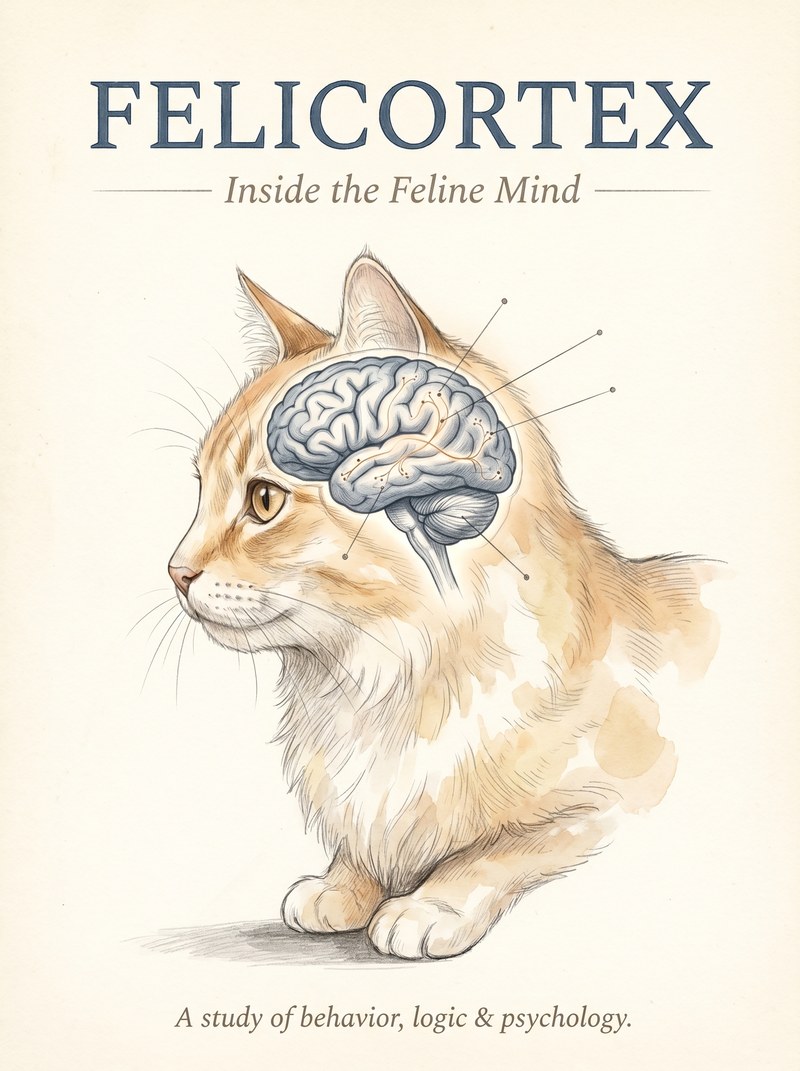
14 chapters. 250+ peer-reviewed studies. The complete neuroscience, psychology, and behavioral logic of the domestic cat — translated into something you can actually use.
$29.97
$9.97
— today only
The science exists. It just hasn't reached you yet.
Not opinions. Not myths. Not Pinterest tips. Real animal behavior science, translated for cat owners who want to actually understand the creature in their living room.
How feline neurology builds a parallel reality — and why your cat experiences the same room you do, completely differently.
40 million years of evolution still running in the background of every house cat — and what that means for how they see you.
The invisible map your cat lives inside — and why understanding it solves 80% of the "behavior problems" you've been guessing at.
The Cambridge Declaration on Consciousness, the Oregon attachment study, and the science of feline emotion — beyond the myths.
Every signal — ears, eyes, tail, posture — decoded with the science behind it. You'll never misread your cat the same way again.
The maternal instinct hidden in every "gift" — and what it actually reveals about how your cat has categorized you.
Why most cats live in chronic, invisible stress — and the early warning signs every owner should recognize before they become disease.
Fear-based, redirected, territorial, and play aggression — read the signals before they escalate, and never be "surprised" by a bite again.
Yes, your cat loves you. The neuroscience proves it — and shows you exactly which behaviors are the proof.
No guesswork. No "experts say." Every chapter draws on research from the world's leading veterinary behaviorists, animal cognition labs, and neuroscience institutions.
Each chapter ends with a "What You Can Do" section that translates the science into practical changes for your cat's daily life.
How your cat processes the world — basic feline neuroscience and why their reality is genuinely different.
The evolutionary legacy that shapes every cat — and why your cat is not a small dog.
How cats organize their world — territorial mapping, pheromones, and the zones that rule feline life.
What does your cat actually feel? Fear, pleasure, attachment, frustration, and chronic stress decoded.
Reading your cat from head to tail — the slow blink, ear positions, tail signals, and full posture.
Why cats meow only at humans, the science of the purr, and what every chirp, trill, and growl actually means.
The maternal instinct hidden in prey delivery — and what it reveals about how your cat sees you.
Chronic stress, its physical consequences, and the early warning signs every owner should recognize.
Fear-based, redirected, territorial, and play aggression — reading the signals before they escalate.
The hidden territorial conflicts in homes with more than one cat — and how to defuse them.
Why play isn't optional — it's emotional nutrition. The science of the SEEKING circuit.
Attachment styles in cats, how they choose their primary human, and the science of the human-feline relationship.
Yes, you can train a cat. Here's how — using operant conditioning the way feline cognition actually works.
Cognitive decline, senior cat care, the dignity of the elder feline — and how to honor them through it.
The common assumption — that dogs are sociable and cats are aloof, and that this is merely a personality difference — misses the deeper point entirely.
Dogs and cats are not personality variants of the same psychological type. They are the products of radically different evolutionary strategies, and those strategies produce radically different emotional architectures.
Dogs evolved to read human social cues with extraordinary precision because their ancestors' survival depended on navigating the human social world. Cats took a different path. They tolerated humans. They co-existed with them. Over millennia, they adapted to live alongside us without ever abandoning the fundamental operating system that evolution had spent millions of years writing: the solitary predator's manual.
A 2019 study by Kristyn Vitale and colleagues at Oregon State University, published in Current Biology, tested whether cats show secure base effects similar to those documented in dogs and human infants. In a modified Strange Situation protocol, 70 cats and kittens were briefly separated from their owners and then reunited.
Approximately 65% of cats showed secure attachment patterns — returning to balanced exploration after reunion rather than displaying anxious or avoidant responses. This challenges the popular narrative that cats are simply indifferent to their owners. They do form attachments. They simply express them differently — and more selectively...
Every chapter reads like this — clear, science-based, and built to change how you see your cat.
I've read maybe a dozen cat books. This is the only one that actually changed how I behave around my cat. Within a week, our relationship was different.
Finally, a book that treats cats with intellectual seriousness. The chapter on feline emotions made me cry — I've been misreading her this whole time.
My cat had been "randomly" aggressive for years. Reading the chapter on redirected aggression solved it in three days. Worth a hundred times what it costs.
Reads like a great science book — Bradshaw, Bekoff, that level. But applied. I keep going back to the body language chapter every time something new happens.
I bought this for myself and ended up giving copies to four other cat owners I know. Everyone needs this book.
It's the difference between guessing and knowing. I'll never go back to guessing again. The territorial mapping chapter alone is worth the price.
14 chapters. 120 pages. The complete science of the feline mind. Instant download. Read on any device.
You save $20 — limited-time launch pricing
Get Instant AccessFelicortex is delivered as a high-quality PDF that works on every device — phone, tablet, computer, e-reader. After payment, you receive the download link instantly via email. No shipping. No waiting.
Every claim in Felicortex is backed by peer-reviewed research. The book draws on more than 250 studies from leading veterinary behaviorists, animal cognition researchers, and neuroscience labs at institutions including Oregon State, Bristol, Sussex, Tufts, and Ohio State. Researchers cited include John Bradshaw, Kristyn Vitale, Tony Buffington, Sarah Ellis, Karen McComb, and many others.
Absolutely. Felicortex is written for cat owners, not for academics. The science is translated into clear, narrative prose — readable in single sittings, with no jargon. If you can read a magazine article, you can read this book. Every chapter ends with a "What You Can Do" section that turns the science into practical changes you can apply immediately.
Most cat books offer either basic care advice (how to clip nails, what food to buy) or pop-psychology generalizations. Felicortex is different: it's the underlying science of feline cognition, emotion, and behavior — the actual why beneath everything your cat does. It's the book you read once and keep returning to whenever something new happens with your cat.
Because Felicortex is a digital download — instantly delivered to your inbox after payment — all sales are final. This is the industry standard for digital products. To help you decide before purchasing, we provide an extensive preview on this page: chapter descriptions, sample text, the full table of contents, and the science behind the book. Please review these carefully and email us at hello@felicortex.com if you have any questions before buying. You can read our full Refund Policy for details.
Yes. The standard retail price for Felicortex is $29.97. The $9.97 price is our launch offer — running for a limited window so we can build the first wave of readers and reviews. Once the launch period ends, the price returns to $29.97. If you're seeing this page now, you're seeing the lowest price the book will ever be.
Yes — Chapter 10 is dedicated entirely to multi-cat households, including the territorial dynamics, resource allocation, and conflict patterns that are nearly invisible to most owners. If you have more than one cat, this chapter alone is likely to change your home.
Currently Felicortex is available as a digital edition only. This lets us deliver it instantly, keep the price low, and update it as new research emerges. You can easily print it at home if you prefer reading on paper.
The science exists. It's clearer than ever. And for less than the cost of a coffee, you can hold all of it in your hands today.
Get Felicortex for $9.97Instant download · Lifetime access · 120 pages